
This first appeared in JMWW 2013
Origins: Amy Nawrocki talks about the inspiration for her poem “Lucifer Falls, New York,” which appears in the summer 2013 issue of jmww:
Lucifer Falls, New York
Like war planes, a crowd
of raptors scull through the blank
and cloudless sky. One
after another, they stream
over the open paddock
of midsummer green, advance
toward a still and speechless
line of trees. Their portents
reach the forest’s door; needles
of pine brace between hard clay
and treachery. The bone black jaw
of a red-bellied snake ruins
a toad’s last chance for escape.
He is in the middle of it now,
like the fawn whose femur lay
furloughed in the gorge,
trespassing on the slick ink
of river-smoothed black rocks.
Three months before the wedding, my husband and found my wedding band in a jewelry story in Ocean City, repacked the car and headed north to the Finger Lakes of New York state, country of Riesling and pungent artisanal cheeses. The campsite was crowded, bright and hot, but at night we roasted corn on the cob, popped toasted marshmallows with raspberries into our mouths and sipped on cream sherry. Eric and I are avid hikers, so in between wine tasting and lake cruises, we strapped on the boots and took to the gorges and waterfalls outside Ithaca.
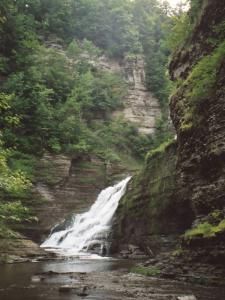
The hike took us in and out of pine forests, to the top of the falls, a look out to the valley below. Though elsewhere the waterfalls were in full bloom, the August heat had dried up much of the gorge. Coming down from a high causeway, we slipped into the riverbed, full of downed trees and glossy rocks. And bones. My foot was acting up, deciding for no reason at all to drag and clench awkwardly; and the clumsiness of my gait was frustrating, heartbreaking and incomprehensibly scary. There were tears. I wasn’t used to feeling vulnerable and unsteady. Perhaps something of that came to mind at Lucifer Falls.
I have always seen the beauty in witnessing what the natural world seems to do so flawlessly: go on. Insects go about the business of laying eggs and feeding on plants. Skies turn gray, then black, then back to blue. Water ekes out of gorges a little at a time; the deluge masking the exactness of liquid carving water through dense stone over centuries. Space makes us forget the tactile and the immediate: gravel beneath feet, the whisper of pine needles; lightning scars and burls on mighty trees. A snake swallowing a frog, its feet twitching in the finality of a meal. Bones recently part of a muscular beast, now driftwood.
The raptors circling are on the lookout for something good to eat. There’s no reason to think their meals are destructive, sad, hateful or evil. In the poem, I wanted to capture the eeriness, signal something like warning, to tap into the alertness of those birds. Animals are all about awareness. I think it’s good to remind ourselves of that. The fawn bones trouble us (or I imagined they would trouble a reader) because we impose our own wishes to stave off the end. We want the little deer to grow up big and strong, lead a happy life. We root for the underdog; maybe the frog will escape. Maybe my foot will doom me. We turn our fears on the landscape and see omens, not beauty.
I wish I could say that I dreamt up the title as a comment on the poem’s meaning, but in fact Lucifer Falls really exists, one of the best gorges outside Ithaca in the heart of the Finger Lakes. There’s something to that authenticity, that somebody else saw the expanse and contrasts in the landscape and thought, somehow, of fallen angels.
 Amy Nawrocki