Origins, Lucifer Falls

This first appeared in JMWW 2013

Origins: Amy Nawrocki talks about the inspiration for her poem “Lucifer Falls, New York,” which appears in the summer 2013 issue of jmww:

Lucifer Falls, New York


Like war planes, a crowd
of raptors scull through the blank
and cloudless sky. One
after another, they stream
over the open paddock
of midsummer green, advance
toward a still and speechless
line of trees. Their portents

reach the forest’s door; needles
of pine brace between hard clay
and treachery. The bone black jaw
of a red-bellied snake ruins
a toad’s last chance for escape.
He is in the middle of it now,
like the fawn whose femur lay
furloughed in the gorge,
trespassing on the slick ink
of river-smoothed black rocks.

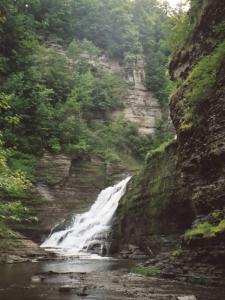
Three months before the wedding, my husband and found my wedding band in a jewelry story in Ocean City, repacked the car and headed north to the Finger Lakes of New York state, country of Riesling and pungent artisanal cheeses.  The campsite was crowded, bright and hot, but at night we roasted corn on the cob, popped toasted marshmallows with raspberries into our mouths and sipped on cream sherry. Eric and I are avid hikers, so in between wine tasting and lake cruises, we strapped on the boots and took to the gorges and waterfalls outside Ithaca.

The hike took us in and out of pine forests, to the top of the falls, a look out to the valley below. Though elsewhere the waterfalls were in full bloom, the August heat had dried up much of the gorge. Coming down from a high causeway, we slipped into the riverbed, full of downed trees and glossy rocks. And bones. My foot was acting up, deciding for no reason at all to drag and clench awkwardly; and the clumsiness of my gait was frustrating, heartbreaking and incomprehensibly scary.  There were tears. I wasn’t used to feeling vulnerable and unsteady. Perhaps something of that came to mind at Lucifer Falls.

I have always seen the beauty in witnessing what the natural world seems to do so flawlessly: go on. Insects go about the business of laying eggs and feeding on plants. Skies turn gray, then black, then back to blue. Water ekes out of gorges a little at a time; the deluge masking the exactness of liquid carving water through dense stone over centuries. Space makes us forget the tactile and the immediate: gravel beneath feet, the whisper of pine needles; lightning scars and burls on mighty trees. A snake swallowing a frog, its feet twitching in the finality of a meal. Bones recently part of a muscular beast, now driftwood.

The raptors circling are on the lookout for something good to eat. There’s no reason to think their meals are destructive, sad, hateful or evil. In the poem, I wanted to capture the eeriness, signal something like warning, to tap into the alertness of those birds. Animals are all about awareness. I think it’s good to remind ourselves of that. The fawn bones trouble us (or I imagined they would trouble a reader) because we impose our own wishes to stave off the end.  We want the little deer to grow up big and strong, lead a happy life. We root for the underdog; maybe the frog will escape. Maybe my foot will doom me. We turn our fears on the landscape and see omens, not beauty.

I wish I could say that I dreamt up the title as a comment on the poem’s meaning, but in fact Lucifer Falls really exists, one of the best gorges outside Ithaca in the heart of the Finger Lakes. There’s something to that authenticity, that somebody else saw the expanse and contrasts in the landscape and thought, somehow, of fallen angels.
Close Reading the Wood-pile

About this time every year, when the leaves begin to fall and the soil is perpetually wet and cushiony, I begin to long, strangely enough, for comfortable measurements. The three deer who’ve visited our lawn came back this second morning, so that’s a start. The tiny, unrecognizable bird (sparrow? finch?) fluttered in and out of the green down of a dense cedar pine. She disappeared into the brush, gone long enough for me to miss her, then darted back into sight without a “word to tell me who [she] was.”

Scanning the autumn woods and contemplating birds and future snow, I spot a recently constructed woodpile and recall Robert Frost’s poem “The Wood-pile.” Like my fluttering finch and grazing deer, I’d like to be “someone who [lives] in turning to fresh tasks” enough to forget the handiwork raking leaves, snapping photos, tracing straight lines. Enough to read the landscape with the mind to “go on farther.”

This close-read of the poem appeared in the winter 2007-2008 issue of Umbrella: A Journal of Kindred Poetry and Prose.

the wood pile

In the often overlooked poem “The Wood-Pile,” Robert Frost explores the human life cycle, particularly the process of aging. The speaker is in a middle stage of life, about to embark on the winter of old age, which corresponds to the setting of the poem. Because the speaker is “out walking” in this cold setting, “far from home,” he is transplanted and in an uncomfortable environment. The reader can surmise that a transformation is likely to take place here. The first scene’s elements, “hard snow,” the view of trees “all in lines” that were “too much alike to mark by name or place” give a bleak and uncertain sense to the scene. In this manner, nature is discomforting. It is only the “hard snow” that keeps him there, as the culmination of his life work in old age will give purpose.

He encounters a bird; the bird leads him to a woodpile bound by a tree and a stake. We can read that the bird’s literal purpose is to show dissimilarity between man and bird and the misunderstanding that occurs between them, largely due to the bird’s innocence or naiveté. Bird and narrator are separated literally by a tree: “He was careful/To put a tree between us when he lighted.” Metaphorically, they are separated by age and wisdom. The bird represents a youthful figure, being “small” and foolish, taking “everything said as personal to himself,” as one unsophisticated in the ways of the world might do.

Similarly, like a young person, the bird mistakenly thinks the speaker is after his tail feather. The white feather, in contrast to winter’s white, could be taken as a symbol of innocence. Like the trees that are “too much alike to mark or name a place by,” the bird gives “no word to tell me who he was.” Both the tree and bird’s identities are lost in anonymity. Before the speaker is able to forget the bird for the pile, he must let the bird lead him there. These lines serve not only as transitions, but as thematic devices. Perhaps in his own younger days, he might have gone the way of the bird, but now does not wish the bird “good-night.”

With his description of the woodpile, the speaker contrasts earlier images by stating “not another like it could I see.” Unlike the trees and bird, the decaying woodpile is unique. He also moves from living images to the “dead” woodpile, and here the poem takes a dramatic turn. Frost states, “It was older sure than this year’s cutting,” telling us that the woodpile represents the declining years of life. A pristine quality prevails near the pile as “no runner tracks…looped near it.” And: “The wood was gray and bark warping off it/And the pile somewhat sunken.” Such lines evoke an aging man, his hair grey and his head balding, his body and bones sloped drooping. The vine, like a man’s work, wraps or consumes his life, a theme that echoes in the last lines. The growing tree and falling stake contrast, and represent what holds the aging man—his living familial ties and his cane.

At the emotional fulcrum of the poem, the poet looks at what has come before—the bird, the pile—and works toward a contemplative resolution. The final lines are the antithesis of what has come before, showing us there is purpose. On the one hand, the poet asks what kind of person could leave such art idle, while on the other asserts that art has a function of its own. In aging, we often think our usefulness will decay and we will be abandoned by “someone who lived in turning fresh tasks.” But Frost does not leave the pile “far from a useful fireplace” without final value. Though abandoned, it “warms the frozen swamp.” In a remarkable reversal of common thought, Frost conjectures that it may be in the winter of life when we find fulfillment. He certainly concludes that work and art have persistent, smoldering meaning, even beyond a living end.


Wildness: Voices in the Sacred Landscape

Check out this great new anthology. In celebration of the 5th anniversary of its founding, Homebound Publications is pleased to announce the publication of Wildness: Voices of the Sacred Landscape, featuring 19 authors including David K. Leff, L.M. Browning, Gunilla Norris, Theodore Richards, Gary Whited, Eric D. Lehman, and me.

Anthology_cover_fin

Here’s a teaser from my essay “Choosing Peregrine.”

This peregrine is not too much bigger than a crow or mourning dove, but unmistakable, once I finally find her in my assisted gaze. We piece together the story.

Support Homebound, an independent, socially and environmentally conscious publisher. Purchase your copy today. Celebrate beauty; choose love. Be kind.

erics wildness quote