Origins, Lucifer Falls

This first appeared in JMWW 2013

Origins: Amy Nawrocki talks about the inspiration for her poem “Lucifer Falls, New York,” which appears in the summer 2013 issue of jmww:

Lucifer Falls, New York


Like war planes, a crowd
of raptors scull through the blank
and cloudless sky. One
after another, they stream
over the open paddock
of midsummer green, advance
toward a still and speechless
line of trees. Their portents

reach the forest’s door; needles
of pine brace between hard clay
and treachery. The bone black jaw
of a red-bellied snake ruins
a toad’s last chance for escape.
He is in the middle of it now,
like the fawn whose femur lay
furloughed in the gorge,
trespassing on the slick ink
of river-smoothed black rocks.

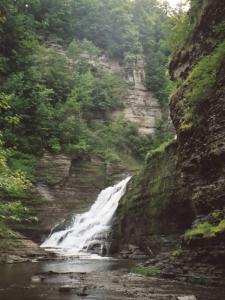
Three months before the wedding, my husband and found my wedding band in a jewelry story in Ocean City, repacked the car and headed north to the Finger Lakes of New York state, country of Riesling and pungent artisanal cheeses.  The campsite was crowded, bright and hot, but at night we roasted corn on the cob, popped toasted marshmallows with raspberries into our mouths and sipped on cream sherry. Eric and I are avid hikers, so in between wine tasting and lake cruises, we strapped on the boots and took to the gorges and waterfalls outside Ithaca.

The hike took us in and out of pine forests, to the top of the falls, a look out to the valley below. Though elsewhere the waterfalls were in full bloom, the August heat had dried up much of the gorge. Coming down from a high causeway, we slipped into the riverbed, full of downed trees and glossy rocks. And bones. My foot was acting up, deciding for no reason at all to drag and clench awkwardly; and the clumsiness of my gait was frustrating, heartbreaking and incomprehensibly scary.  There were tears. I wasn’t used to feeling vulnerable and unsteady. Perhaps something of that came to mind at Lucifer Falls.

I have always seen the beauty in witnessing what the natural world seems to do so flawlessly: go on. Insects go about the business of laying eggs and feeding on plants. Skies turn gray, then black, then back to blue. Water ekes out of gorges a little at a time; the deluge masking the exactness of liquid carving water through dense stone over centuries. Space makes us forget the tactile and the immediate: gravel beneath feet, the whisper of pine needles; lightning scars and burls on mighty trees. A snake swallowing a frog, its feet twitching in the finality of a meal. Bones recently part of a muscular beast, now driftwood.

The raptors circling are on the lookout for something good to eat. There’s no reason to think their meals are destructive, sad, hateful or evil. In the poem, I wanted to capture the eeriness, signal something like warning, to tap into the alertness of those birds. Animals are all about awareness. I think it’s good to remind ourselves of that. The fawn bones trouble us (or I imagined they would trouble a reader) because we impose our own wishes to stave off the end.  We want the little deer to grow up big and strong, lead a happy life. We root for the underdog; maybe the frog will escape. Maybe my foot will doom me. We turn our fears on the landscape and see omens, not beauty.

I wish I could say that I dreamt up the title as a comment on the poem’s meaning, but in fact Lucifer Falls really exists, one of the best gorges outside Ithaca in the heart of the Finger Lakes. There’s something to that authenticity, that somebody else saw the expanse and contrasts in the landscape and thought, somehow, of fallen angels.
Why We Walk

The_Funeral_of_Shelley_by_Louis_Edouard_Fournier

Byron and Shelley

As we trudged along the varied paths
of the Highland Way you did not let go
to cry, though legs ached with pain
and skewed nerves slipped out of place
screaming for you to stop.

Our last night before we go home,
I read Trelawny’s Recollections
of the Last Days of Shelley and Byron:
Percy’s funeral muddies my mind,
but I cannot unhinge the sable-eyed rival
or the torture of a lame and disfigured foot
that shamed Byron all his days. How skilled
we are at pushing our deformities into
the deepest alcove then turning away from them,
lest they outpace and overcome us.

A red-haired boy—more than a boy—
a young man—travels with us
on the flight back home. His father
who is grey and wears glasses
accompanies him. I see that the boy
is blind, and think he is—how
to say this kindly—lame of mind,
though as I watch him and his father
pace back to their seats, I see that he is
purely sightless, and I feel cruel for thinking
it was something more. All this time

I thought that it was me we were walking for,
the mess upon me and the volume of days
yet unwritten tensing with uncertainty,
smudged with hieroglyphs of caned figures
and the imposing arc of wheels.
Waiting out the rain in Philadelphia
my head slumped in exhaustion, your legs
extended in a futile stretch, I grasp
what it was we were really walking for:

the German girls whom we’ll not see again;
for Gerry, our sturdy guardian, agile as a buoy,
flecks of white in his hair and a harness of years
on his back; for the moments between the rain;

what every boy’s blindness wants to possess;
for Byron’s feet and the contents of Shelley’s coat pockets
washed up on a shore we haven’t yet visited
and may not ever walk upon.

The poem appears in Reconnaissance, published in 2017 by Homebound Publications. Louis Édouard Fournier, The Cremation of Percy Bysshe Shelley, oil on canvas, Liverpool, Walker Art Gallery, courtesy of Wikipedia Commons

From Nomad’s End, Finishing Line Press, 2010

Before Your Train Leaves

a handful of minutes need to morph
into their shape, crust like atoms
becoming a molecule and tell a story
with thrift. No time to dawdle.
Back-story, established by your eyes,
advances the plot, though I am more interested
with the syllables of touch than
the tactility of speech. We pool
into the sparse bed and handle
each other like pottery clay, mold ourselves
into familiar shapes. I smooth
your back as moments hoof between
the walls of the room. They assemble
in the sphere of a clock above our heads.
Before your train leaves, the hands
will complete their circle; our story
will end as most do, with goodbyes
filling the grooves between scripts.

IMG_9162

Companionship and Inspiration

Sing to Me
Sing to me, Oh heavenly Muse,
Sing of the sea, “wine dark” and full of mysteries;
Sing your generous musings into my untamed ears,
Guide me to places where islands peek out and crest from the ocean’s swell of waves.

Speak to me of sailing, foreign speaking travelers, roads and pathways winding and      steep, gravel covered, tree-lined and mountain rich, those which frame
the ocean’s mighty blue-black plentitudes in their sights.

Sing to me of gannets; the birds of prehistory captured in flight, white winged with sun-touched caps and eyes blue as the empty sky.

Sing to me of porcupines, earth dwellers of the spiny quills, shy and clover-munching; Sing of rabbits tramping through forests, stealing a moment to look out and survey the
open path, only to scurry playfully into the underbrush.

Bring to my ears the far-away call of the coyotes, watching over the mountain campsite. Bring to me news of whales, giants so gentle in their swimming, the sea’s expanse seems hardly touched by their brawn.

And Muse, bring to me tidings of love, companionship, a hand that reaches out and takes me into the pleasing sunshine, so that we will walk toward the horizon and find a
moment now and then to make love among the brilliant colors in the expansive catastrophe of this world.

For Eric

????????????????????????????????????
West Rock Ridge