Workmanship

Thanks to the Connecticut Poetry Society for posting my poem “Building a House” in their “members’ poems” link (see menu bar under “MORE”). You’ll also find tributes and contest information. Join today and help support the written and spoken word.


Building a House
by Amy Nawrocki

On our usual walks, mud gushing
into hiking boots and creeks humming
in quiet trickles, we stop to marvel
at beavers’ work: trees taken down
by fierce teeth, graveyards of stumps
constructed like missile heads. I think:
what careful precision there is in the shreds
of bark wisped in circular piles.
While no clear path is laid to water,
we know they are building dams–
secret tunnels under the silted lake.
There is no doubt—this is work.

Swimmers always, one beaver, intent
on warning us away, slaps the water
with his tail. Instinct and survival
feed his business, not vanity
the way we piece together a room.
Unable to fathom the carefulness, the absolute
technicality of such workmanship, I tell you
how humble I feel, too dumbfounded to believe
these little creatures and their craft. You hold
out your hands to show me how big a beaver is–
bigger than I think—and we carry on
down the path into the car and back
to the house we have built together.

As our house begins to fail,
tiny spaces crack the floor and stairways
and break down the fiber of wood.
When the insulation begins to peel away,
we fight, busy as beavers, to keep it
together. We grit our teeth, burrow
into walls, and cart the hard parts away
with jagged teeth and leather tails.

Escaping the hook

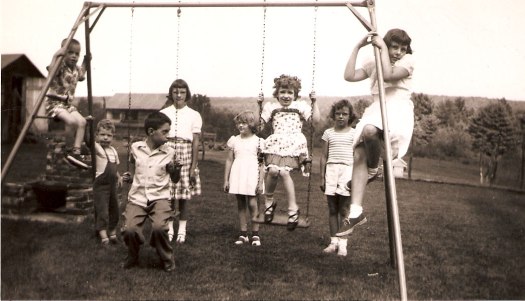
I’m looking forward to an upcoming post-Christmas family reunion. Here is one of my favorite poems from Potato Eaters, my first chapbook from Finishing Line Press. The photo, too, is one of my favorites, found in an attic box years ago. That’s my mother, on the right, and two of her brothers on the left.

Click the yellow BUY NOW button found at the bottom of the page (or this link) to order a signed copy.

Fishing with My Brother

My brother, who is prone to nosebleeds
hasn’t the efficiency to heal wounds;
on his left arm burn marks permanently
blister. His chin bears the scar of the second
fall on the steep hill below the house.

You can’t get any better than that
he says, pushing the fishing line
into my face. Of all the fish ever
to swim in this pond or that, this
one decides to end life on a hook,
its flesh torn and gaping. We
could take a lesson, learn when to give
up, when to know enough is enough.

dana-john-ferne-swingsetHe throws the fish back. How did he become
so elemental? How did he know
the average heart cannot drown
itself too deep, forgetting its purpose?
I want to tell him walk a bit with me
and we’ll cry to the birds who nest by us
in the fairy tale. He’ll listen, I hope.
I can’t wait to see him plant fields, discover
electricity, and cut a strong path
through jungles. But there will be time for that.
Nine times out of ten, it is speed
that breaks us; we grow too fast
trying to fly, or escape the hook.

The Perils of Bedtime Reading

With A Brief History of Time occupying the top spot of my pile of bedside books, I’ve had space and time on my mind lately. So, four poems (small input, I know) toward a unified theory of the universe.

The Sky’s Version of Truth

So what about the laziness
of light, taking its sweet old time
getting to the eye. The sky
having no reason to be false
teaches memory, a peek
of what old people must have seen:
Cassiopeia learning to dance, Orion
earning his bow, Taurus deciding
to charge. A navigator’s dream.
What the eye catches is an old light.

What we rely on most is thriftiness.
Whatever speed it takes,
the open road is just dotted lines
a tree’s last goodbye to summer,
just lament. It’s a different kind
of blindness—seeing too much
seeing with the heart, light alone
or a blade of grass.
Loving the blindness, the eye sees a pattern:
the round dome of sky,
the traffic of night, ad infinitum.
Connect the dots the sky is saying.

I see a banjo, the spokes of a wheel,
the claw of a crow catching me. Maybe
a duck-billed platypus playing the trumpet.
I can almost hear a star’s last sigh.
Perhaps legacy is spelled out
the way memory returns to you
so many years later: you remember
the leaves, the rain, the sound
of a breath stopping three rooms away.


Time Travel

The summer after the diagnosis
we visited their beach house on the Cape,
taking the route through those warped
highways, drawbridges, and rotaries
made for delirium.

What to talk about with my mother’s friends
but the growth of children and the palace
of sea breeze, while the bug zapper
murdered hordes of bugs. What to say
of radiation treatment? What to say
of closure, that our meeting here
is the beginning of goodbye.

That night I met neighborhood kids,
joined them for bonfire and beers,
and dreamt of snakes.


After the First Kiss

Venus enters the fourth chamber,
meanders like a comet
through the claret landscape.
Finding it pleasantly blood filled,
she maroons and takes in the scope,
settles where the black holes leading
to outer galaxies close and open
mechanically, leaving no light.

Reclining with the boon of ancient history
pulsing like a red giant around her,
it’s no wonder she feels safe here
in the calibrated darkness. It is time,
she thinks, to postulate the theory,
time to introduce a little magic
into this hollow topography.

And with the red shift, she exits
taking with her tales of time travel
and the red fire of oxygen.
Slipping past the mouth’s gate,
she exchanges the good air and leaves
the secrets of human love.


While Constellations Sleep

I press my lips against your cheek,
brush a loose strand from your head,
and fold into midnight blue slumber.
Night watches over its sleepyheads
as a dim light trickles between the slant
of the curtains—perhaps the moon,
perhaps a lonely streetlight peeking in,
searching for companions to embrace.
The kittens tiptoe in, waking me to gaze
silently out the window. But I cannot see
the stars tonight; Orion’s belt brightens
someone’s sky beyond the clouds, beyond
the glossy shell of New Haven’s bubble of light.
The dippers are out of reach, the dragon

has slowed his brutal tail, resting above
the horizon. But I see the constellations
of your face even as you sleep. Wishing
to rescue light from the galaxies you dream,
I trace the pattern of your eyelashes and
telescope into the nebula of your love.
DSC_0357

First Day of Class

Prototype

Bless the first day of class
with its confined clutter. Notebooks
stacked and piled like sculptures
that say to the first lesson, I am ready
for you to feed me. Catapult us
into the realms of academia.
Picture chimpanzees swallowing
pineapple-white sheets in open cages.

Get your hands dirty, I tell them,
love the pages, the print, smell it
and remember papyrus. Break
the spine, hold it up to the light:
tell me who you are, author, tell
me your secrets; help me make sense
of your world. Transmogrify.
Cave dwellers, hierophants—make friends
with the exclamation point, bond
with the asterisk. Play with dirt.
Play with dirty words.

dsc_0411

Ordinary Acts

A Gathering of Sorts

DSC_0424

As morning curdles its way to noontime,
autumn plays its lazy guitar.
To join the living world,
we make our way to the post office
with enough change in hand for three stamps.
Their duty is delivering messages:
a utility bill, the insurance payment, a letter
to a friend. In the front of the line,
a woman’s daughter spins
and spins in her orbit.
Gathering packages in his arms,
a man, Santa-like in tweed jacket
and leather cap, stands beside
a painter covered in plaster.
He sways and looks away
from us, staring instead into
the clouds of his day.

Each day we perform ordinary acts:
we teach algebra, refinance mortgages,
cook dinner, journey to the moon.

Each day a mixture of light and color
penetrates our trust. We place our faith
in little things: the oak’s red summit,
a stamped envelope,
holding the door for each other
as we enter and leave each other’s lives.

Shadows of Paris

OLYMPUS DIGITAL CAMERA

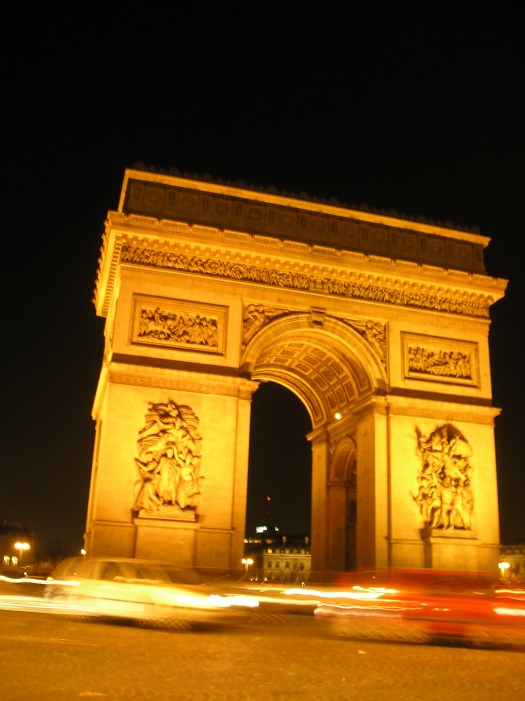
In honor of Eric D. Lehman’s novella Shadows of Paris winning the Silver Medal from Foreward INDIES Book Award, here is my poem from Lune de Miel.


History of a Table


The bar where Henry Miller drank

tenders a thin table beneath a mirrored wall

scoping author’s portraits and patrons who filter

into booths and pout with espresso mouths.

I am only apprenticing Paris. We’ve scrapbooked

ourselves here to dip into the ink of artists like us

who came to loot and ransack the city, to hunt

amid gray, cobbled streets, take the surly and brooding

pelt of phenomenon and deposit a littered alphabet

of new and debaucherous talismans. My pen

trembles, and I ache to write myself into a version

of original sin, revel in the profanity of life,

and spit into my inkwell.  Beneath Hemingway

my new husband scribbles in his moleskin.

I fix my eyes toward the ring on his hand.


By the time my cocktail abandons me

I have taken custody of the deserted chronicles

left long ago on tap handles and between floorboards.

My husband closes his book; we leave on the table

a handprint of coins and a pocket of space.

The apprenticeship ends with the looted winter air

sweeping us into the amulet of the Paris night.

OLYMPUS DIGITAL CAMERA