Forecast
Thinning sycamores
dance in the turbulent gray
gossip of thunder.
A cathedral sky beckons—
the steel rain is not far off.

poet
Forecast
Thinning sycamores
dance in the turbulent gray
gossip of thunder.
A cathedral sky beckons—
the steel rain is not far off.
Perforations
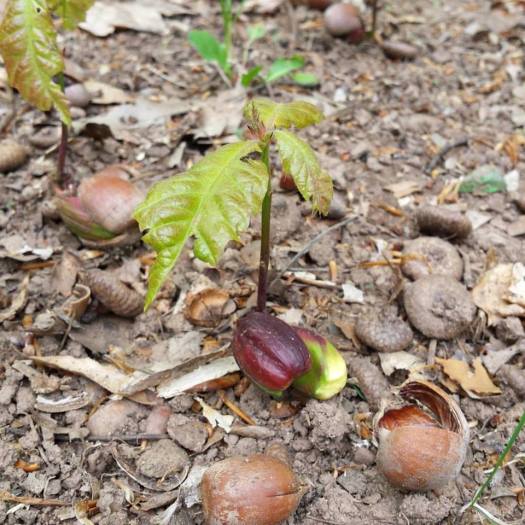
acorns spackle a plot
of grass, denting the earth
with such humble perforations
not one is destined to rootand
and yet their collective persistence,
their uniform, haphazard conglomerating
whets the fertile expanse
of the damp and formless ground
so many puncture wounds—
nature’s indeterminate
guarantee against finality

My poem, “What I forgot to Ask” was recently selected for the Austin International Poetry Festival Anthology di-verse-city. The poem found its way into the world after I watched a peregrine falcon lunch on a nuthatch in my front lawn. The nuthatch is unconfirmed, and “lawn” is a generous term for the smattering of beeches and oaks in front of the house.
I missed the reading in Austin, but I’ll savor anthology when it arrives–a long list of talented poets. To order a copy click here. Celebrate National Poetry Month with a bird, cat, human, or mouse of your choice.
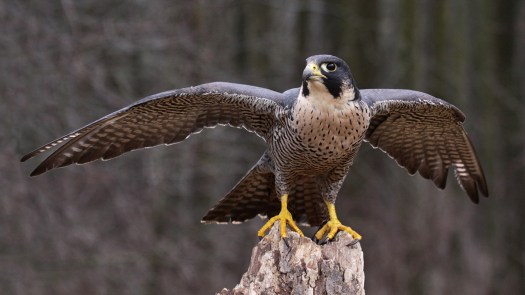
(photo courtesy of National Geographic)
What I Forgot to Ask
I do it all the time, mistake flight for freedom;
escape for repentance. If only,
like a peregrine, I didn’t have to explain
my silences or defend my stealth. She descends
cliff ledges with confidence under cover
of camouflage. I cannot leave
this nest of caked mud and broken twigs
or cradle the updraft between fingers.
Too much captivity makes a girl tired.
What language do you have
for the barren days when nothing catches your eye,
when speed doesn’t win? Is there ever an hour
when you want no wings? to tuck feathers away
and wobble on talons like a cripple?
Tell me about the wind, the kind
that quiets fear and lengthens your cries
into inaudible whispers. When do you rest?
For more peregrine inspired work, see my essay “Choosing Peregrine” in the Homebound Publications anthology, Wildness: Voices of the Sacred Landscape
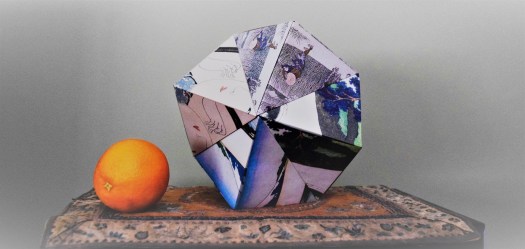
Dodeca Hexahedron with Blood Orange, Amy Nawrocki, Origami paper and rubber cement.
The sculpture is sixteen triangular hexahedrons glued together created a twenty-four sided sculpture, inspired by the geometric insight and modularity of artists like of Sol LeWitt, Alexander Calder, and others. “Dodeca Hexahedron” is a guess. Soccerball was the alternate.
Here’s a poem from Reconnaissance (2015 Homebound Publications), inspired by LeWitt’s work.
Distilling Sol Lewitt
Obliterate, says the line,
the curve of the horizon; resist
tremors of an inexact hand;
tap into the statuesque control
of an oblique axis, lingering
in the infinite advance; find proof
of existence between the abscissa
and the ordinate, between Euclid
and Descartes, between an arrow
and its trajectory.
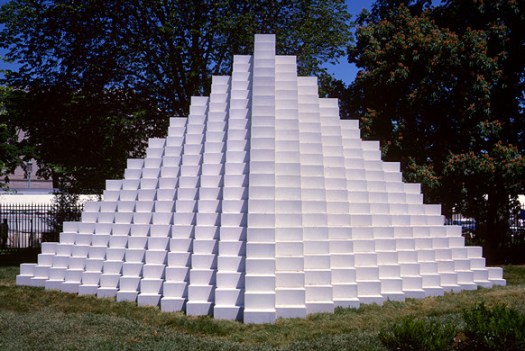
Sol LeWitt, Four Sided Pyramid, concrete blocks and mortar, National Gallery of Art
My villanelle “Returns” was selected as a finalist for the 2016 Pangaea Prize from The Poet’s Billow. Click below to check it out, along with the other winners and finalists. Many thanks to the editors.
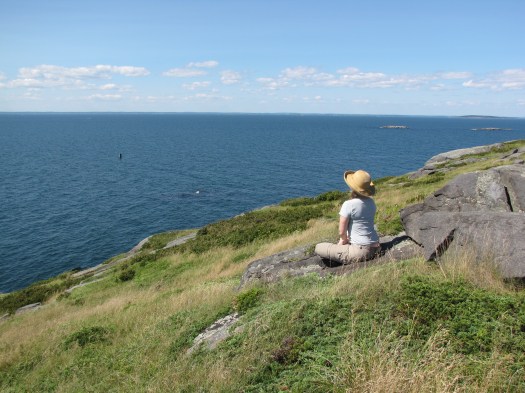
Thanks to Joe and KJ at Black Tie Lunchbox for the opportunity to talk poetry! Hear the episode (link below)
Source: Episode 11: Amy Nawrocki

A wintery poem from Lune de Miel, Paris honeymoon, marriage, aging, and how the past maps itself out in pieces to be collected when you get there.
At the Café Select
Rue Montparnasse bustles outside the café window. It seems that there are very few hours of daylight in the Paris winter, though perhaps when something is condensed we can find the best part of it, like the pulp of a nut. As I watch passers-by folly onward, I listen to the voice of an American man talk about his life to a companion. I’m surprised when I turn my head to see that she is a younger woman. With my back turned to him, I imagined him telling his story to an old Navy buddy or a colleague he’s met for business. She is my age and this reminds me that I’m a week away from my thirty-fifth birthday. I hear him tell her about success, and he uses words like celebrate and thrive. But then his voice dims and I wonder if perhaps he’s slipped into French; perhaps I am just lost in the gloomy sidewalk, the gray pavement only a few shades deeper than the sky.
Later I catch him say that he doesn’t feel like a success; he pauses and continues with “in some ways more than a success.” “I have survived,” he notes. I guess his age to be seventy, perhaps, a few years younger than my father when he died, a few years younger than the ash-haired woman with a cane who passes by the window. The woman wears a tweed coat that falls just past her knees; her pale stockinged legs move slowly, even with the aid of a third. Her success is quieter, though both journeys have fought off the closing of many hours. I doubt that this as an adequate measure of success, though I like the simplicity of such an idea, as if all we had to do was float like tree branch down a long river.
The café-crème is cold by the time I turn my attention back to it, and having to strain now to hear their conversation, I lose interest in the man and his companion. Instead, I glance up to see my new husband writing a story about a little Danish boy whose mother dies. I think of my father and mother who both missed our wedding, and I wonder about the river’s end. As my thirty-fifth year comes to its end, I may be halfway there, to the moment when I recount my hours and ponder the scope of my successes. For now, I put on my own tweed coat, reach for my husband’s hand, and trace another’s steps down the boulevard.
Click on “a story about a little Danish boy. . . ” 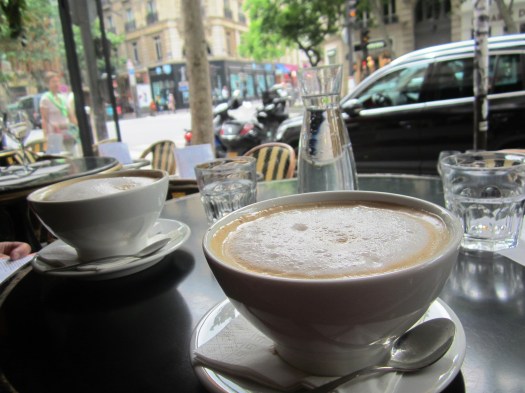 for the current issue of The Passed Note, a journal which features “The Wind Barrons of the Pharo Islands” by Eric D. Lehman, the very story described.
A selection of my poems was recently published in Sixfold journal. Many thanks to the editors and the Sixfold poetry community. Poems are selected by popular vote by multiple readers. With tomorrow’s predicted snowfall, here’s the link and a few teasers:
Waiting for the Plowman
In the morning: Rousseau’s Confessions. Breakfast:
something forgettable and unfulfilling, toast,
the white of an egg circling a shiny yolk.
By midday, the desert of chalk buries the laurel
and watching juncos burrow under the feeder
suffices for motion. Blank under its plastic face
the kitchen dial signals two o’clock with sleek
anemic hands. Within the hour, sugar held
in the spoon’s mouth is let go into black liquid,
and boots, scuffed and sheltered alert the tangled
knit scarf to concoct itself. At four, shovel in hand
I depart to do the job myself. The man
and his truck are nowhere to be found
even though the blizzard’s end is new
and he promised and there is a lot of it.
Lighter than a pile of proverbial feathers
but sticky and heaping, the first bundle I take
begins to build a dune around the driveway
but there is nowhere else to go and no rest
and nothing to do to lessen the white
except to bend at the knees and let it fly.
Literally
She says without irony or modesty
I’m literally so irritated, as if irritation
could be anything other than literal . . .
Bad Girls
The boy at the pub had blonding hair
and a round face
and we were cruel to him. . . .
Instead of Poems
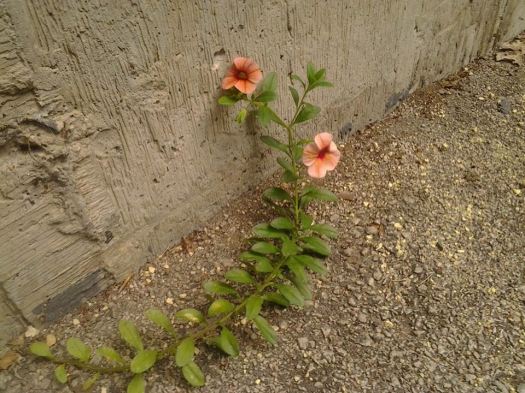
Instead of poems, I weed the sidewalk
and empty crevices of intruders.
Preparing for tomorrow’s class, I remembered this essay from 2012 posted on Books New Haven:
Why are people so afraid of poetry? That’s a question that’s been plaguing poet Amy Nawrocki, of Hamden. Now, with her new collection, Lune de Miel, being released in August, she talks …
Source: Is poetry too hard? Amy Nawrocki, Hamden poet, gives a resounding NO and explains why
Copies of Lune de Miel, which came out in 2012 can be purchased by clicking the tab: Purchase Signed Copies.
Generous Bruises
At the bank the teller catches me
counting on my fingers—the same feeling
I had chasing my sister’s bike down
the unpaved road. She would fall before
I could catch her. As the road curved
I was thinking how little I have
to rely on; I should run faster.
Caught in the act of failing, used up again
dwelling in those Hopper paintings
where nothing vacillates, nothing
is weak, and all the women wear black pumps.
Their isolation—so original, it makes them
efficient, but keeps them separate.
But consider this: a crystal’s structure
appears only when cracked. We experience
the same self when the I cracks
and our breath runs out. We earn
the favor of being by breaking
revealing a symmetry so generous it bleeds.
 Watching a bruise heal from the inside out
it’s the color that matters:
never black nor blue, but shades of yellow
and one hundred degrees of plum.
 Amy Nawrocki