Upcoming Events

October 8, 2016

Join me, Marilyn Nelson and Eric D. Lehman at Byrd’s Books in Bethel Connecticut for a Poetry and Fiction reading.

November 29, 2016

I’ll be reading at the Connecticut Forest and Park offices in Middlefield, CT at 7:00 p.m. This is the kick-off event and the inauguration of the trail’s new Poet Laureate David K. Leff. Joining David will be Connecticut Poet Laureate Rennie McQuilkin.


Not entirely idle

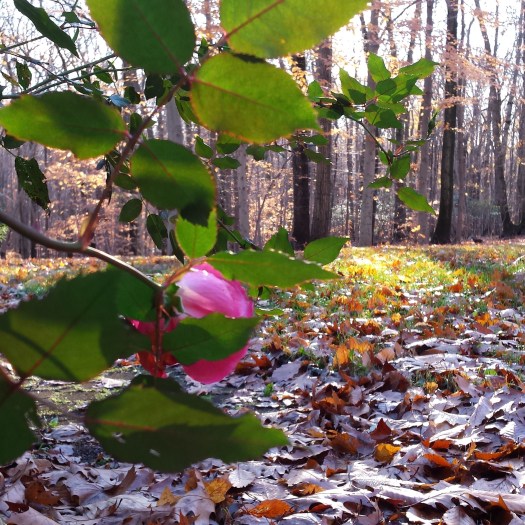
Happy Fall! Here’s a poem from Nomad’s End, published by Finishing Line Press. Purchase a personalized signed copy of the chapbook by clicking here . I’ll pick up the shipping!

img_20151121_102544

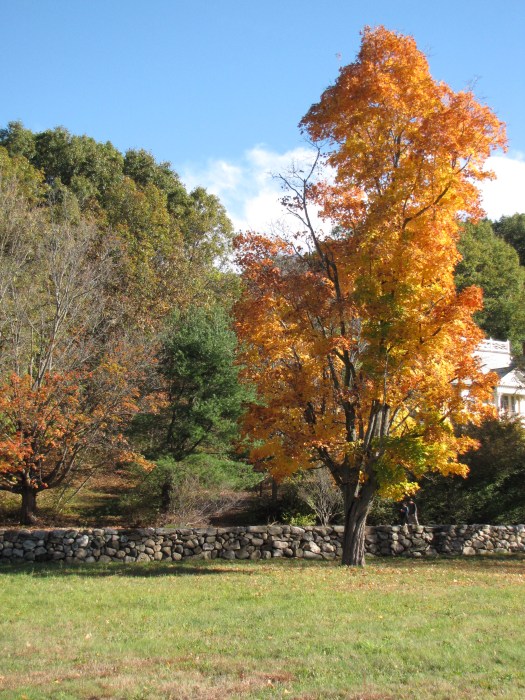
Occupation of Autumn

Afternoon on the last day of September
begins with sun shifting across
the tiara of sky. The equinox has passed
and autumn carefully plots
her revenge against the vacancy of summer.
Bulbs await planting, else
the vernal daffodils won’t appear,
and soon the cascade of burnt orange leaves
will need raking. But for now
the lists of unaccomplished tasks
grow like unweeded sprouts
left to frolic in the dormant flower boxes.

Yet we are not entirely idle
and do our own plotting, opening
the screen door, filling the feeder.
Anticipating migration, it dangles
under the porch overhang, filled
with kernels for sparrows and squirrels.
When they exit for afternoon naps,
the feeder flutters in the soft breeze:
a mirror ball, a festival of white patches
kaleidoscoping in a living room lightshow.
The day continues shifting; soon
the dance of light will vanish
as surely as the frost will come,
purposeful in its vocation.

img_6090

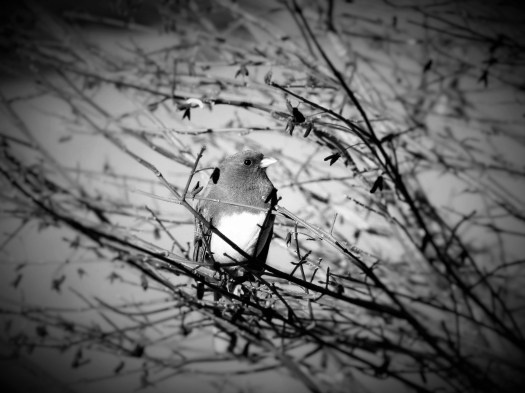
Moon Birds


For the first assignment in Poetry 205, we listened as students shared a poem they loved or one that inspired, intrigued or interested them in some way. The assignment was to listen and jot down any word or phrase that struck your ear and then write a poem from the fragments. I had  a list of over a hundred phrases from poems and this is the end result:


Moon Birds


any gods
who dare to claim the sky

take sorrow
with open throats

leave chalk white arrows
and nothing more


img_3599-2

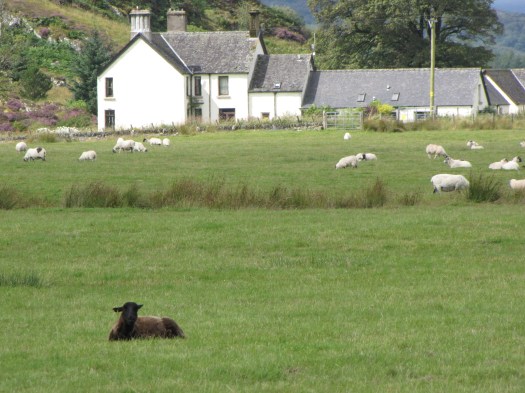
Black Sheep Reflections

Five years ago about this time, Eric and I were on our way back from Scotland. We didn’t take in the entire West Highland Way on foot as planned, but our black sheep guides (all of them) deserve a whiskey toast.

To Leave Is One Thing

By the time we get back to Glasgow
the thistle has turned cottony
and the black sheep who has been our guide
rests quietly, dinned wheels and muddied
exterior, in the parking lot of Arnold Clark’s car hire.

IMG_9409

On the Erskine Bridge, traffic stops
for a suicide, but we are not sad, not really.
To leave is one thing, to depart
without experience sewn into muscle and mind
would be too much.

The cabbie’s loud music turns into an opportunity.
As we approach the airport
we fill our minds of all that came before:

Central Station from the hotel window,
the Highlands materializing through the rain.
Stirling Castle and the cobbled way
toward Aberfeldy. Maple scarf marriage
and the Fortingall Yew. Haggis and scones,
bens, bogs, and roundabouts. Humming
Loch Lomond, and stealing Skye
from Clan Donald. Putting our feet down,
imagining there is no pain.

For nights to come we will dream of thistles.

IMG_9497IMG_9579

34 km from Paris

To celebrate the forthcoming publication of my husband Eric D. Lehman‘s novella Shadows of Paris, I’m posting this poem, not of Paris exactly, but when you read Shadows, you’ll know why this poem makes sense. The characters in his beautifully crafted story also “know something of transformation,” but that’s all I’ll say. You should discover it for yourself. Make your pilgrimage to Homebound Publications and buy your copy. Click again to get  Lune de Miel, where this poem first appeared.

Pilgrim at Auvers
The pigeons at L’eglise Notre Dame know something
of transformation. White broods in a sky that has forgotten
color and the silhouette of clouds. A quiet stroll
through narrow, charcoal streets led me here,
up ancient stone steps to the church where Vincent
van Gogh saw blue-black sky churn in flight around
the toasted edifice. The flock perches until the hint
of something migratory and innate calls them to stir;
in hues of gray they erupt in a smooth arc, returning
to roost on the slants of the high, tilted steeple.
Winter weighs endurance and transition as stone erodes
to dust, leaves compost to mud, and summer flowers
that steadily surveyed August afternoons convert
to dried stalks in frozen dirt. Pilgrims, too, know of shifts
and I walk into the warm and lonely church to wait
for language to come again to my cold lips.
Fifteen hundred hours toll from the bell tower,
a grave listens at the top of the hill, and a downcast sun
aches to paint maize onto the bare winter scroll.

“It would be easier . . . “

Here’s a poem that appeared in Reconnaissance, published by Homebound Publications in 2015.

Long Shot

A good snapshot stops a moment from running away.      ~Eudora Welty

The dilemma is not
about choosing between
architecture or faces,
panorama or close-up,
indirect light or flash

but between
the print’s future frame
and the quiet immobility
of reflection—of just sitting
and being, not worrying
about whether any of this
will be preserved digitally
and remembered in twelve
or thirteen years. Chances are,

tomorrow I will struggle
with recreating the bird
swaggering near my feet. Maybe
in some somnambulant day dream,
I’ll re-see these tiny
daisy-like weeds and hear
the passersby crunch gravel
under lazy sneakers. I might
be able to gather pieces
of foil and flattened cigarettes
from a mind cluttered
with fading poppies
and the leaves of a tree
I cannot name
blowing in a breeze.

It would be easier
if I didn’t love
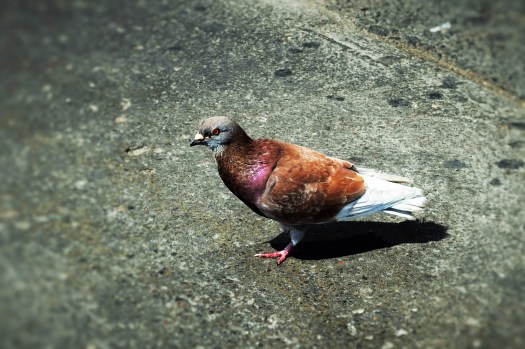
every single pigeon, this one
with his spooky eyes and orange beak—
a single brushstroke
of white and teal beneath his neck,DSC_0294
and if the fence’s shadow
wasn’t so dappled and transient,
if acorns would stop falling
mid-distance between dawn
and dusk, long enough
to preserve their posts
in my mind. If forgoing
the shot and closing my eyes
would be enough to argue against

some future self
who will be too old or sad
or something worse
to remember this.

Check out these other great titles from Homebound Publications including new fiction by L.M. Browning  and Eric D. Lehman, poetry by Andrew Jarvis and James Scott Smith, illustrated children’s literature by Elizabeth Slayton, and nonfiction by David K. Leff.  Add Four Blue Eggs and Wildness: Voices of the Sacred Landscape to your book bag and you’ll be set (for a while)! Support independent publishers and writers who want to make a difference in the world. Save 20% and receive free shipping on orders over $35.00 with coupon code: SUMMERREADING20.


A Gathering of Sorts


IMG_0469A Gathering of Sorts

As morning curdles its way to noontime,
autumn plays its lazy guitar.
To join the living world,
we make our way to the post office
with enough change in hand for three stamps.
Their duty is delivering messages:
a utility bill, the insurance payment, a letter
to a friend. In the front of the line,
a woman’s daughter spins
and spins in her orbit.
Gathering packages in his arms,
a man, Santa-like in tweed jacket
and leather cap, stands beside
a painter covered in plaster.
He sways and looks away
from us, staring instead into
the clouds of his day.

Each day we perform ordinary acts:
we teach algebra, refinance mortgages,
cook dinner, journey to the moon.

Each day a mixture of light and color
penetrates our trust. We place our faith
in little things: the oak’s red summit,
a stamped envelope,
holding the door for each other
as we enter and leave each other’s lives.

Click the title to find Potato Eaters, where this poem first appeared.

IMG_9092

There are, of course, flowers

Reconnaissance yields a bouquet of Quebecois forest flowers for a hot summer day. Un-vase the garden.

Photos from Parc National D’Oka, and Montreal Botanical Gardens

Poem from Reconnaissance, Homebound Publications, 2015

Mrs. Dalloway

There are, of course, flowers;
they fill her hands before any vase,
but even in their glass tomb, she sees
the void they have lent their lives to.
Once the guests arrive, she sinks
between the desire for the most
satisfying success and the deep
and heeding certainty that none of it
prevents the day’s observable artifacts
from passing through the clear,
choking air of an open window.


Threads

20160615_191012

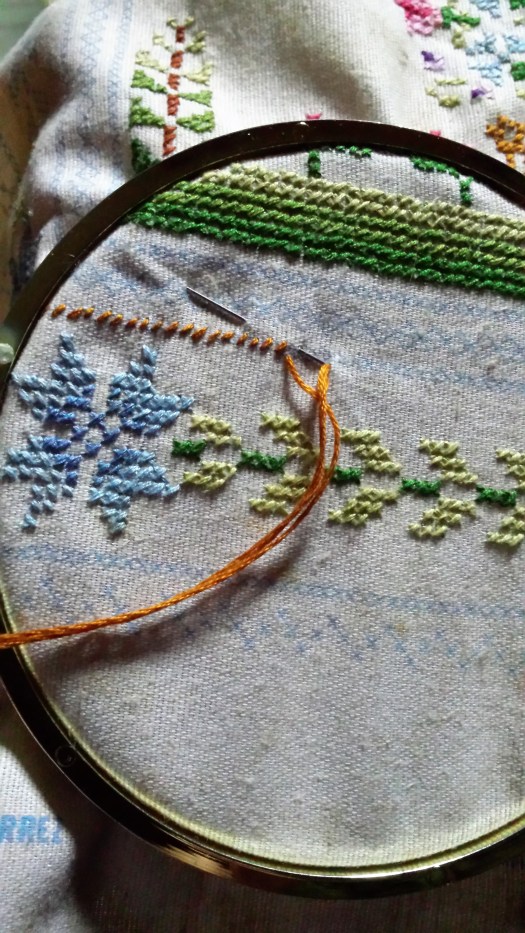
This unfinished cross-stitch tapestry was started (I think) by my mom in 1977. That’s the date stamped on the pattern. I rescued the unfinished project from the old house in one of the many clean-out sessions, found in a walk-in closet along with many other sewing materials, loose fabric swatches, patterns and pincushions, scissors and embroidery floss. It’s been in my closet ever since. The center was finished (a sampler with alphabet and numbers) and about a fourth of the border had already been stitched. The shadow of her original embroidery hoop makes a distinct age mark; it’s gone now, but the needle was left in this position. My suspicion is that she never finished it because in 1978 she gave birth to her fifth child–Erick. She also began to do more quilting and stenciling by then, so her art projects shifted. I hope to finally finish it in time for the birth of her second grandchild, Erick and Shelby’s baby due in September.

Threads

Opening the walk-in closet filled
with the stuff of living—I think
one day we will have to sell the house.
In the meantime, closing the door
as a hatbox falls, there are no poems
about choosing the appropriate dress
for your mother to be cremated in.

As a schoolchild, I learned
when there is anything left over
you must carry it. I’m taught to love
what lingers—the timpani in a slow concerto,
the echo of a lost voice,
the sound, three rooms away
of a breath stopping on its last chord.
Paying its debt, nighttime
closes its eyes and gives itself up
to morning. I think she is sleeping,
so best let her sleep. Keep the cat
from waking her.

I recognize my mother’s hands
on the walls of our house. These are her threads;
the threads I hold onto as I make my way,
always there is a path back.

My first act as an orphan: I choose
the sapphire dress, the best color I know
depicting the moon’s shadow
as it spirals away from the earth.

Before Your Train Leaves

A poem from Nomad’s End, published by Finishing Line Press, 2010.


IMG_20130602_134814 (2)

Before your train leaves

a handful of minutes need to morph
into their shape, crust like atoms
becoming a molecule and tell a story
with thrift. No time to dawdle.
Back-story, established by your eyes,
advances the plot, though I am more interested
with the syllables of touch than
the tactility of speech. We pool
into the sparse bed and handle
each other like pottery clay, mold ourselves
into familiar shapes. I smooth
your back as moments hoof between
the walls of the room. They assemble
in the sphere of a clock above our heads.
Before your train leaves, the hands
will complete their circle; our story
will end as most do, with goodbyes
filling the grooves between scripts.