This may sound easy. It isn’t.

“A poet is somebody who feels, and who expresses [her] feeling through words. This may sound easy. It isn’t.”

E.E. Cummings (or e.e. cummings as he preferred) wrote this advice to a young poet, and my poetry teacher shared it with me when I first started writing. After 27 years, it’s still not easy, but I can’t stop, and starting next week, I will write one poem a day for 30 days.

I’ll be participating in Tupelo Press’s 30/30 project, and joining over 175 poets who’ve committed to writing 30 poems in 30 days. Four poets will join me for March, and I’m excited to get started.

We’re all inviting family, friends, and colleagues to sponsor us. It’s not a competition, but we’re all raising money for Tupelo Press, one of the best independent publishers in the country, and a great supporter of poetry. But I need a little more than a retweet or Facebook Like. Support my efforts with a donation.

https://tupelopress.networkforgood.com/projects/47224-amy-nawrocki-s-fundraiser

By sponsoring my 30/30 efforts, you will send me vital encouragement and help the Tupelo Press continue to put more poets into print. Here’s why it matters:

  • Independent literary publishers are mission-driven—they focus on publishing literature.
  • Independent literary publishers provide access to the voices of entire communities.
  • Independent literary publishers produce over 98% of poetry being published each year, and the majority of literature in translation and works of fiction by emerging writers.

Your sponsorship can be at any level; no amount is too small or insignificant.

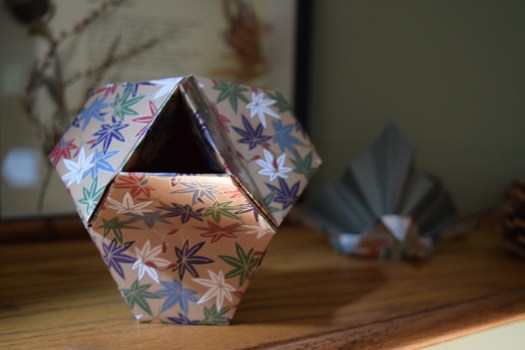
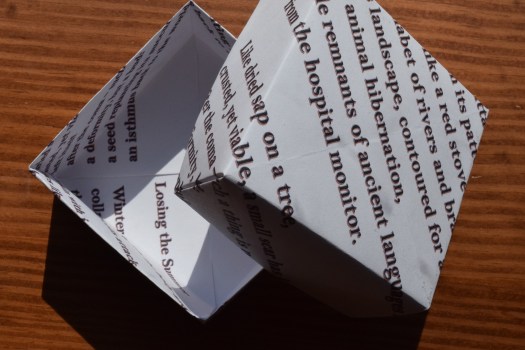
  • For a donation of $10, I’ll send you a personized origami box, designed with one of my poems.
  • For $15, I’ll dedicate a poem to you.
  • If you can support me with $30 (just $1/day), I’ll send you a signed copy of either Four Blue Eggs or Reconnaissance.
  • For a donation of $60 (2 dollars a day), I’ll send you a signed copy The Comet’s Tail: A Memoir of No Memory before its April 10 release date.
  • Customize your donation. Birthday coming up? Need a wedding poem? New baby coming? Retirement? I’m in.

Sponsor Amy Nawrocki

Tupelo Press is a prestigious non-profit press, for seventeen years their mission has been to publish new voices. They are giving my work some exposure, which is sometimes hard to come by.

“If,” continued cummings, “at the end of your first ten or fifteen years of fighting and working and feeling, you find you’ve written one line of one poem, you’ll be very lucky indeed.”

I’m very lucky indeed to have had such great support throughout my writing career. Keep it going and kick off March with me. I’ll post my first poem in just over a week. Follow my progress.

Donate Today

My very best,

Amy Nawrocki


dsc_0411
Sponsor me with a donation of $5 for your very own origami box, personalized with one of my 30/30 poems!


Sculpture

DSC_0480 (3)

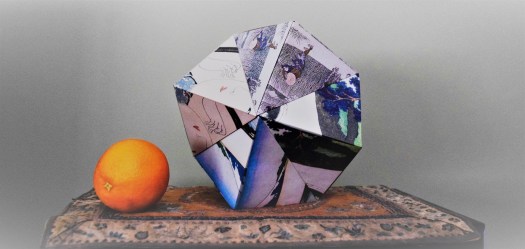
Dodeca Hexahedron with Blood Orange, Amy Nawrocki, Origami paper and rubber cement.

The sculpture is sixteen triangular hexahedrons glued together created a twenty-four sided sculpture, inspired by the geometric insight and modularity of artists like of Sol LeWitt, Alexander Calder, and others. “Dodeca Hexahedron” is a guess. Soccerball was the alternate.

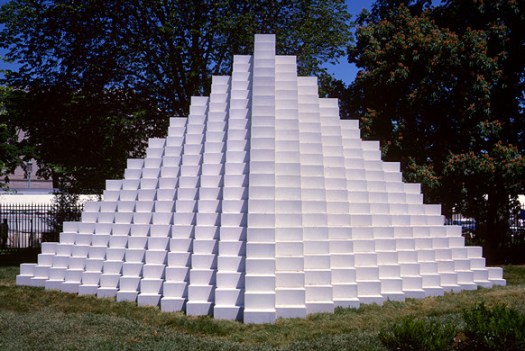
Here’s a poem from Reconnaissance (2015 Homebound Publications), inspired by LeWitt’s work.

Distilling Sol Lewitt

Obliterate, says the line,

the curve of the horizon; resist

tremors of an inexact hand;

tap into the statuesque control

of an oblique axis, lingering

in the infinite advance; find proof

of existence between the abscissa

and the ordinate, between Euclid

and Descartes, between an arrow

and its trajectory.

Four Sided Pyramid Sol Lewitt

Sol LeWitt, Four Sided Pyramid, concrete blocks and mortar, National Gallery of Art

Origin Stories

Watching the documentary Exit Through the Gift Shop,  I again considered the junction between permanence and artistic expression. The film which is about, among other things, street art, made me wonder about the image (or object), the artist, and about what happens to both when the image is done. Gone or preserved. Momentary, like the croak of a frog or lasting like the croak of a frog through the forest of time. dsc_0367

For a while now, Eric has been encouraging me to see the origami I make as more than just folded paper. I know origami is much more than folded paper; it’s ancient, expressive, precise, colorful, intricate, disciplined, beautiful, worrisome, elegant–both object and idea. My pieces mean a lot to me, and I save them. They’re made, crafted with skill (varying levels in my case). While I’m following a pattern, each piece is built with my choice of paper and pattern, creased by a few sensitive fingers that create mountains or valley folds, which become cranes, boxes, pinwheels, decahedrons, fish, turtles, and flowers. Eric thinks they’re amazing. What to do with them?

dsc_0730

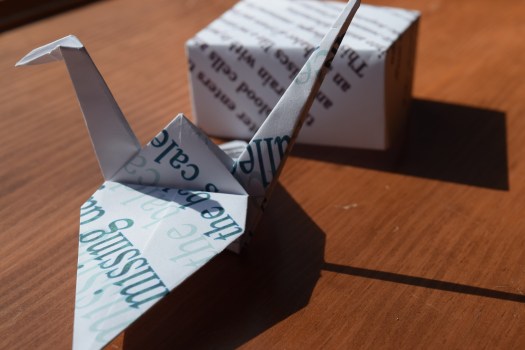
First, we thought of photography as a means to document and also preserve them. (I’ve also tried lacquer, but not so good). Then the photos become art too. Or do they? What about creating a new art form? How . . . maybe why? So far, I’ve come up with versigami–combining poems, shapes, and photography. It’s a work in progress. Here are some of my first efforts.dsc_0402

Poems “Accountability” (crane) and “Losing the Summer” (box) took shape when I printed the text onto the paper then folded it. New? Maybe.

dsc_0425

As part of the process, I had to figure out how to get the text to anticipate the folds, not as easy as I thought it would be. More to the point, I had to start to see ahead to the folds. Where the words appeared on the paper was important. Without the dexterity of a good design program, this proved more complicated than my four-o’clock self really could handle. After a few print outs (and font fun), I could find a balance between words and no words. My poems are more permanent to me in print–for this project I want typed words, not handwritten ones. dsc_0411

There was also the matter of what the actual poem says. I want the words to mean what they mean as a stand alone poem, but also in this new manifestation of versigami. “Losing the Summer” worked well because it’s about, well, loss–the missing pieces. I liked that as a visual theme as much as a written one. dsc_0430

I would like to experiment more with shape, text, process, and finality.

The poem was featured in Four Blue Eggs and recently cited in Gaylord Contributions so maybe versigami a way to reinvent it, update and give it additional life.

Amy Nawrocki was on summer break from her freshman year at Sarah Lawrence College in June of 1992 . . .  [Read more

Origins. Versigami, transience, permanence, folded and unfolded. “Such a thing is not /

“Such a thing is not / dsc_0428a deformity, but a bud.”