Obliterate, says the line
curve the horizon, resist
tremors of an inexact hand
tap into the statuesque control
of an oblique axis, linger
in the infinite advance; find proof
of existence between the abscissa
and the ordinate, between Euclid
and Descartes, between an arrow
and its trajectory.
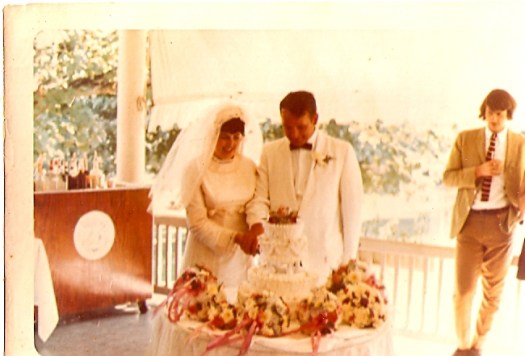
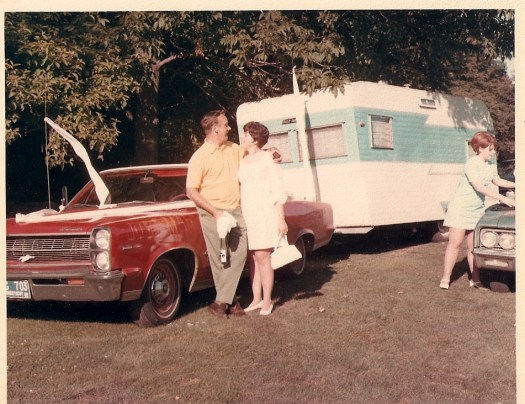
I’m reading a biography of L.M. Montgomery (by Jane Urquhart, Extraordinary Canadians Series), a poignant story of the writer’s life which makes her fiction even more meaningful. The new series Anne with an E is also worthwhile. One of my mother’s favorite books, Anne never made it to my bookshelf until I was much older. My parents, on my mother’s urging I’m sure, honeymooned on Prince Edward Island in 1970. To honor what would have been their 47th wedding anniversary, here is my poem.
The Resuscitating Tonic of Make-Believe
After the fifth or sixth closing of a now tethered
hardback edition, (her grandmother’s copy)
she sent Anne of Green Gables back
to the bookcase without ceremony or accolades
with only the guarded impulses of a pact
made between bosom friends: a girl and a book.
Even before her young lips knew
the timid inklings of what might
be later recognized as true love,
she had the entire exploit pinned down
like tissue paper patterned onto checkered gingham.
Someday, she’d bring him, her own Gilbert,
whoever he might manifest as, wherever
she might find him, to red clay sea cliffs of Anne’s
Prince Edward Island, leave the silk dress,
tuxedo jacket and champagne toasts behind
at the chapel, board the ferry and seek out
the lake of the shining waters, where fields
of tall grasses swoon in the breeze and hollyhocks
chime like wedding bells. But someday seems
an unreachable planet when one is thirteen.
The resuscitating tonic of make-believe begins
to peter out like a late August waterfall; thirsty
pragmatism piles up where once fluid imaginings
squeezed between a book’s secretive folds. Flipping
to the last page, she predicts that happily-ever-after
will look good pressed into malleable paper,
but such endings, with their achieved resolutions,
belong only to red-headed heroines, not real girls
who collect bookmarks and play tuba in the band.
The poem appears in Reconnaissance, published by Homebound Publications; second edition 2017 is now available.
To celebrating the release of the second edition of Reconnaissance, enjoy this poem about first editions. Click the title to order your own first edition at a special discounted price.
I apprenticed well. For a sixth grade project,
Mrs. Montecalvo taught me the worth
of a good forgery when she assigned
the footnoted history of a painter
and encouraged an attempt at imitation.
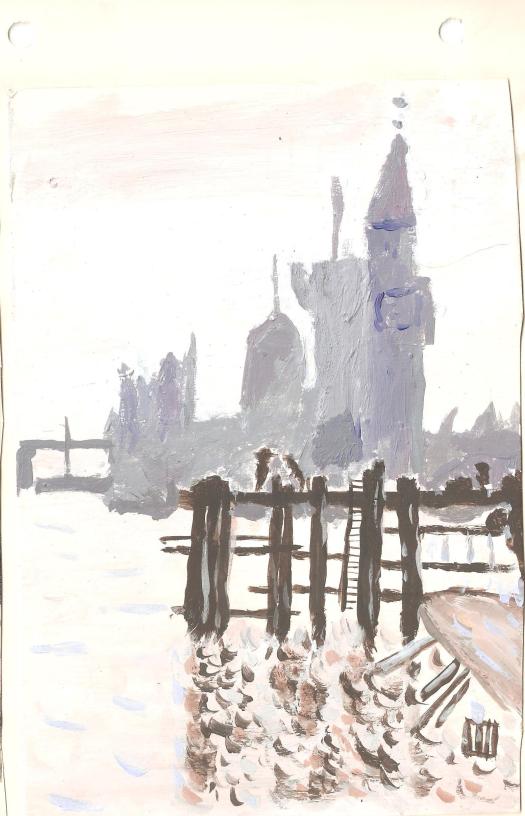
Seeing Monet’s Westminster Bridge reprinted
in Reader’s Digest, I modeled my own
with schoolgirl brushes and an aptitude
for blending. I typed his biography
on a blue Remington, stenciled a title page,
punched symmetrical holes and glued
the masterpiece into a pocketed folder.
I never got the stink of acrylic off my fingers.
After Monet: Westminster Bridge, Acrylic on paper, circa 1985
Audacity and small victories: these
are gateways for any scavenger.
Once one is secure in the false flat
of a sloped horizon, transformations
are easy: an open book, so to speak.
I pocketed the Collected Poems
of ee cummings wholesale, tore
the bar code from the last page
and slipped its frayed spine between
loose-leaf sheets of unlined
but perforated notebooks. Long after,
the card catalog entry went away too.
Like other trophies, I just stored it,
held it in a box of pressed flowers
and half memorized poems, among
generous piles of pens and paint brushes,
newspaper clippings and dirty love letters
scribbled on the backs of postcards.
For these corruptions I’ve paid only
in callouses and broken pencil tips.
Despite my best calligraphy,
slippery pens have crossed out
entire lines carefully typeset in Linotype
or Century Schoolbook, my marks bleeding
through pages now unreadable.
In the gray area between homage
and sacrilege, I thieve too much:
red wheelbarrows pile full of leaves and dirt
and burnable logs pressed into the pulp
of scrap paper or woven into stretchable
canvases. Little I see in nature
that is my own. I stole van Gogh’s sadness
and painted it on my shoulder.
Like Olympia, I learned how to stare.
Next time, let me mimic the syntax of bridges
and throw sand over wet, stolen ink.
Let me trust in surveillance. Once the thief
learns to discern original from run of the mill
everything is a first edition; everything
is one of a kind.
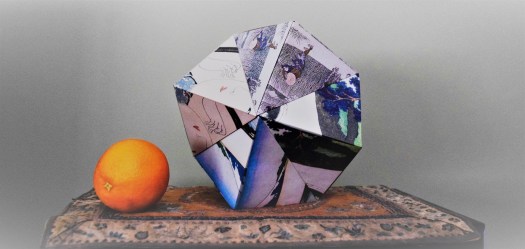
Dodeca Hexahedron with Blood Orange, Amy Nawrocki, Origami paper and rubber cement.
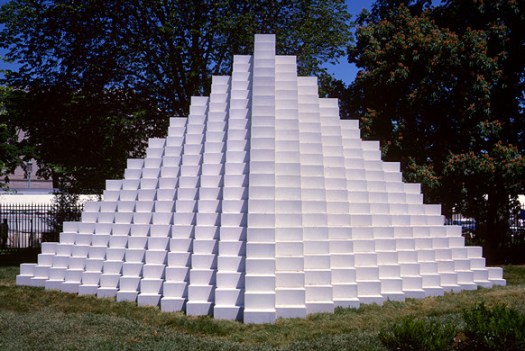
The sculpture is sixteen triangular hexahedrons glued together created a twenty-four sided sculpture, inspired by the geometric insight and modularity of artists like of Sol LeWitt, Alexander Calder, and others. “Dodeca Hexahedron” is a guess. Soccerball was the alternate.
Here’s a poem from Reconnaissance (2015 Homebound Publications), inspired by LeWitt’s work.
Distilling Sol Lewitt
Obliterate, says the line,
the curve of the horizon; resist
tremors of an inexact hand;
tap into the statuesque control
of an oblique axis, lingering
in the infinite advance; find proof
of existence between the abscissa
and the ordinate, between Euclid
and Descartes, between an arrow
and its trajectory.
Sol LeWitt, Four Sided Pyramid, concrete blocks and mortar, National Gallery of Art
Many thanks to a little boy named Ezra (and his expert crocodile tears) and Mark Rothko for filling my time at AAA as I waited to get my new 44-year-old license. I have to admit that it felt a little awkward giving up on Lucretius, who got me through a registration renewal at the DMV last year. But Rothko’s The Artist’s Reality: Philosophies of Art gave me encouragement:
“The Truth of Art is foremost. . . . This artistic conscience, which is composed of present reason and memory, this morality intrinsic to the generic logic of art itself, is inescapable” (“The Artist’s Dilemma,” chapter 1)
Thus, musings fromReconnaissance: The Rothko Conundrum
—the Phillips Collection
1.
binary hypothesis
recognizable. a door
two mirrors. eight cauldrons
a house with its roof
green wishing away a marooned horizon
a blood puddle laying
on the upturned walkway
the puddle pretending a dance
the mirror between
2.
an upside-down paragraph
hapless bronze fire
waking the vertical
bottle glass wishing away a citrus horizon
unfinished books. the last pieces
of paper left on the floor
perpendicular mischief
3.
lost fish music. horizontal longing. orange and red on red
wishing away a missing horizon
lost in watertight cathedral windows
burdenless aches. plurality
the singular capture of loss
knowing or not knowing the ending
4.
the house next door
a second window, serenity
ochre hallelujahs caught
on the windowsill
kneeling inside emptiness
sore fences. twice pink horizon
where seraphs go
why envelopes open
quadrilaterally quiet
five times red
I’ll be reading at the Connecticut Forest and Park offices in Middlefield, CT at 7:00 p.m. This is the kick-off event and the inauguration of the trail’s new Poet Laureate David K. Leff. Joining David will be Connecticut Poet Laureate Rennie McQuilkin.
Here’s a poem that appeared in Reconnaissance, published by Homebound Publications in 2015.
Long Shot
A good snapshot stops a moment from running away. ~Eudora Welty
The dilemma is not
about choosing between
architecture or faces,
panorama or close-up,
indirect light or flash
but between
the print’s future frame
and the quiet immobility
of reflection—of just sitting
and being, not worrying
about whether any of this
will be preserved digitally
and remembered in twelve
or thirteen years. Chances are,
tomorrow I will struggle
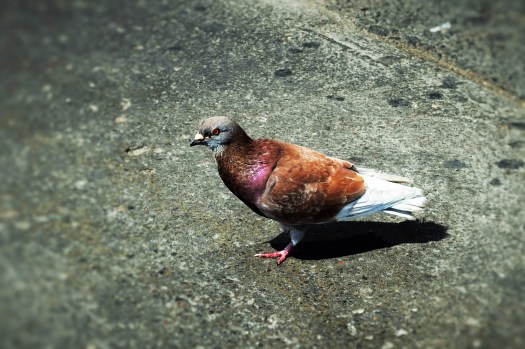
with recreating the bird
swaggering near my feet. Maybe
in some somnambulant day dream,
I’ll re-see these tiny
daisy-like weeds and hear
the passersby crunch gravel
under lazy sneakers. I might
be able to gather pieces
of foil and flattened cigarettes
from a mind cluttered
with fading poppies
and the leaves of a tree
I cannot name
blowing in a breeze.
It would be easier
if I didn’t love
every single pigeon, this one
with his spooky eyes and orange beak—
a single brushstroke
of white and teal beneath his neck,
and if the fence’s shadow
wasn’t so dappled and transient,
if acorns would stop falling
mid-distance between dawn
and dusk, long enough
to preserve their posts
in my mind. If forgoing
the shot and closing my eyes
would be enough to argue against
some future self
who will be too old or sad
or something worse
to remember this.
Check out these other great titles from Homebound Publications including new fiction by L.M. Browning and Eric D. Lehman, poetry by Andrew Jarvis and James Scott Smith, illustrated children’s literature by Elizabeth Slayton, and nonfiction by David K. Leff. Add Four Blue Eggs and Wildness: Voices of the Sacred Landscape to your book bag and you’ll be set (for a while)! Support independent publishers and writers who want to make a difference in the world. Save 20% and receive free shipping on orders over $35.00 with coupon code: SUMMERREADING20.
Reconnaissance yields a bouquet of Quebecois forest flowers for a hot summer day. Un-vase the garden.
Photos from Parc National D’Oka, and Montreal Botanical Gardens
Poem from Reconnaissance, Homebound Publications, 2015
Mrs. Dalloway
There are, of course, flowers;
they fill her hands before any vase,
but even in their glass tomb, she sees
the void they have lent their lives to.
Once the guests arrive, she sinks
between the desire for the most
satisfying success and the deep
and heeding certainty that none of it
prevents the day’s observable artifacts
from passing through the clear,
choking air of an open window.
I’ve been enjoying Ken Burns’ Jazz documentary on demand lately. Here’s “Birdsongs” from Reconnaissance.
For Charlie Parker and the wind tunnels where, magically and dangerously, creativity may wait.
Birdsongs
Having forgotten
what a line looks like
on a page, I unwrap
a notebook and tune
to Charlie Parker. If I Should Lose You, I’ll wait for the record,
metal now and shiny,
to hiccup into
its grooves. Scattered
over an unseen stave of five
parallel lines, the blue
narcotic notes from
a saxophone scatter
like debris
in a wind tunnel.
Thanks to Timothy Quirk for recording my reading of “Giverny” for Nutmeg Chatter.
With Voices of Poetry in August, I read “The man sitting next to me is reading The Idiot.” You can find this and “Giverny” in Reconnaissance.
Thanks to James Novoa for filming me at Housatonic Community College for my Writers in the Classroom presentation. I’m reading “Aboriculture” which you can find in Four Blue Eggs.



 Many thanks to a little boy named Ezra (and his expert crocodile tears) and Mark Rothko for filling my time at AAA as I waited to get my new 44-year-old license. I have to admit that it felt a little awkward giving up on Lucretius, who got me through a registration renewal at the DMV last year. But Rothko’s The Artist’s Reality: Philosophies of Art gave me encouragement: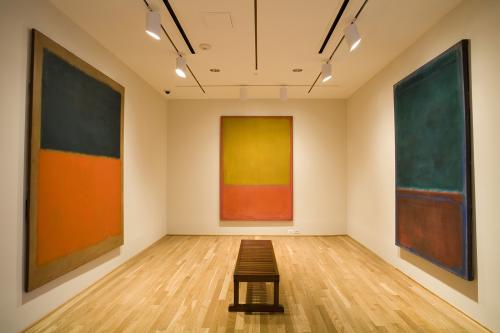




 Amy Nawrocki