Forecast
Thinning sycamores
dance in the turbulent gray
gossip of thunder.
A cathedral sky beckons—
the steel rain is not far off.
Forecast
Thinning sycamores
dance in the turbulent gray
gossip of thunder.
A cathedral sky beckons—
the steel rain is not far off.
To celebrating the release of the second edition of Reconnaissance, enjoy this poem about first editions. Click the title to order your own first edition at a special discounted price.
I apprenticed well. For a sixth grade project,
Mrs. Montecalvo taught me the worth
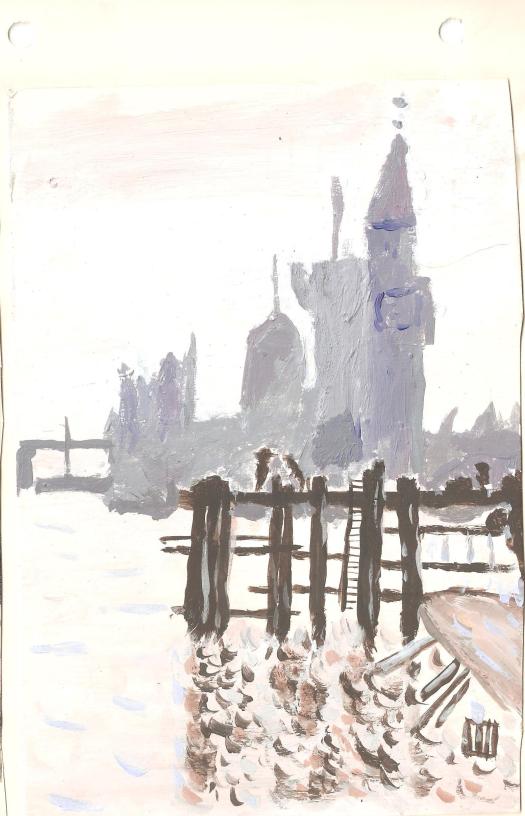
of a good forgery when she assigned
the footnoted history of a painter
and encouraged an attempt at imitation.
Seeing Monet’s Westminster Bridge reprinted
in Reader’s Digest, I modeled my own
with schoolgirl brushes and an aptitude
for blending. I typed his biography
on a blue Remington, stenciled a title page,
punched symmetrical holes and glued
the masterpiece into a pocketed folder.
I never got the stink of acrylic off my fingers.

Audacity and small victories: these
are gateways for any scavenger.
Once one is secure in the false flat
of a sloped horizon, transformations
are easy: an open book, so to speak.
I pocketed the Collected Poems
of ee cummings wholesale, tore
the bar code from the last page
and slipped its frayed spine between
loose-leaf sheets of unlined
but perforated notebooks. Long after,
the card catalog entry went away too.
Like other trophies, I just stored it,
held it in a box of pressed flowers
and half memorized poems, among
generous piles of pens and paint brushes,
newspaper clippings and dirty love letters
scribbled on the backs of postcards.
For these corruptions I’ve paid only
in callouses and broken pencil tips.
Despite my best calligraphy,
slippery pens have crossed out
entire lines carefully typeset in Linotype
or Century Schoolbook, my marks bleeding
through pages now unreadable.
In the gray area between homage
and sacrilege, I thieve too much:
red wheelbarrows pile full of leaves and dirt
and burnable logs pressed into the pulp
of scrap paper or woven into stretchable
canvases. Little I see in nature
that is my own. I stole van Gogh’s sadness
and painted it on my shoulder.
Like Olympia, I learned how to stare.
Next time, let me mimic the syntax of bridges
and throw sand over wet, stolen ink.
Let me trust in surveillance. Once the thief
learns to discern original from run of the mill
everything is a first edition; everything
is one of a kind.
Perforations

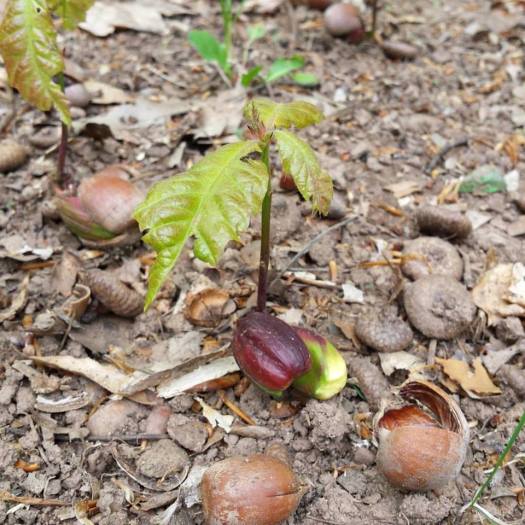
acorns spackle a plot
of grass, denting the earth
with such humble perforations
not one is destined to rootand
and yet their collective persistence,
their uniform, haphazard conglomerating
whets the fertile expanse
of the damp and formless ground
so many puncture wounds—
nature’s indeterminate
guarantee against finality

Celebrate National Poetry Month with the West End Poetry Society, recorded April 15 and featuring Sonya Huber, Amy Nawrocki, Joan Seliger Sidney, Elizabeth Thomas and Faith Vicinanza. The reading was also a fundraiser for the St. Francis Hospital Mandell Center for Multiple Sclerosis.
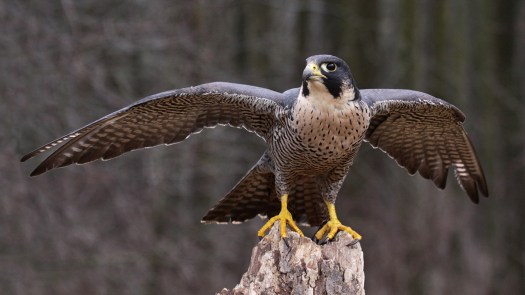
My poem, “What I forgot to Ask” was recently selected for the Austin International Poetry Festival Anthology di-verse-city. The poem found its way into the world after I watched a peregrine falcon lunch on a nuthatch in my front lawn. The nuthatch is unconfirmed, and “lawn” is a generous term for the smattering of beeches and oaks in front of the house.
I missed the reading in Austin, but I’ll savor anthology when it arrives–a long list of talented poets. To order a copy click here. Celebrate National Poetry Month with a bird, cat, human, or mouse of your choice.

(photo courtesy of National Geographic)
What I Forgot to Ask
I do it all the time, mistake flight for freedom;
escape for repentance. If only,
like a peregrine, I didn’t have to explain
my silences or defend my stealth. She descends
cliff ledges with confidence under cover
of camouflage. I cannot leave
this nest of caked mud and broken twigs
or cradle the updraft between fingers.
Too much captivity makes a girl tired.
What language do you have
for the barren days when nothing catches your eye,
when speed doesn’t win? Is there ever an hour
when you want no wings? to tuck feathers away
and wobble on talons like a cripple?
Tell me about the wind, the kind
that quiets fear and lengthens your cries
into inaudible whispers. When do you rest?
For more peregrine inspired work, see my essay “Choosing Peregrine” in the Homebound Publications anthology, Wildness: Voices of the Sacred Landscape

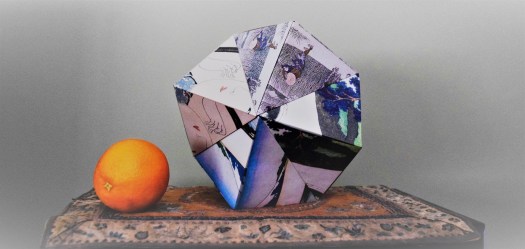
Dodeca Hexahedron with Blood Orange, Amy Nawrocki, Origami paper and rubber cement.
The sculpture is sixteen triangular hexahedrons glued together created a twenty-four sided sculpture, inspired by the geometric insight and modularity of artists like of Sol LeWitt, Alexander Calder, and others. “Dodeca Hexahedron” is a guess. Soccerball was the alternate.
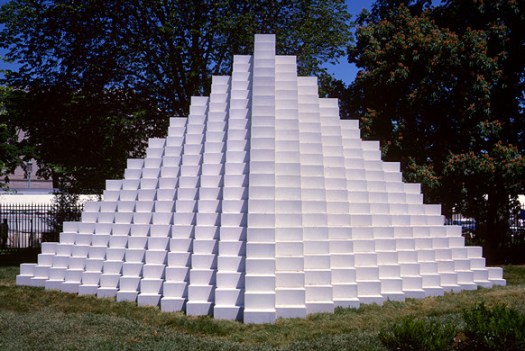
Here’s a poem from Reconnaissance (2015 Homebound Publications), inspired by LeWitt’s work.
Distilling Sol Lewitt
Obliterate, says the line,
the curve of the horizon; resist
tremors of an inexact hand;
tap into the statuesque control
of an oblique axis, lingering
in the infinite advance; find proof
of existence between the abscissa
and the ordinate, between Euclid
and Descartes, between an arrow
and its trajectory.

Sol LeWitt, Four Sided Pyramid, concrete blocks and mortar, National Gallery of Art
My villanelle “Returns” was selected as a finalist for the 2016 Pangaea Prize from The Poet’s Billow. Click below to check it out, along with the other winners and finalists. Many thanks to the editors.

Thanks to Joe and KJ at Black Tie Lunchbox for the opportunity to talk poetry! Hear the episode (link below)
Source: Episode 11: Amy Nawrocki

Watching the documentary Exit Through the Gift Shop, I again considered the junction between permanence and artistic expression. The film which is about, among other things, street art, made me wonder about the image (or object), the artist, and about what happens to both when the image is done. Gone or preserved. Momentary, like the croak of a frog or lasting like the croak of a frog through the forest of time. 
For a while now, Eric has been encouraging me to see the origami I make as more than just folded paper. I know origami is much more than folded paper; it’s ancient, expressive, precise, colorful, intricate, disciplined, beautiful, worrisome, elegant–both object and idea. My pieces mean a lot to me, and I save them. They’re made, crafted with skill (varying levels in my case). While I’m following a pattern, each piece is built with my choice of paper and pattern, creased by a few sensitive fingers that create mountains or valley folds, which become cranes, boxes, pinwheels, decahedrons, fish, turtles, and flowers. Eric thinks they’re amazing. What to do with them?
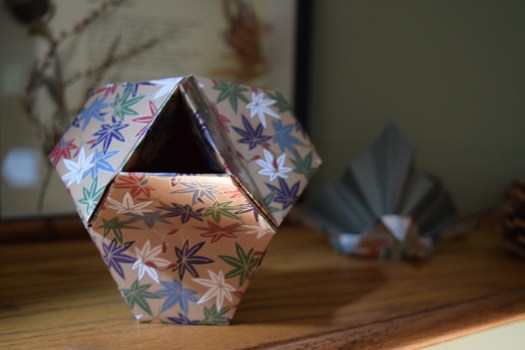
First, we thought of photography as a means to document and also preserve them. (I’ve also tried lacquer, but not so good). Then the photos become art too. Or do they? What about creating a new art form? How . . . maybe why? So far, I’ve come up with versigami–combining poems, shapes, and photography. It’s a work in progress. Here are some of my first efforts.
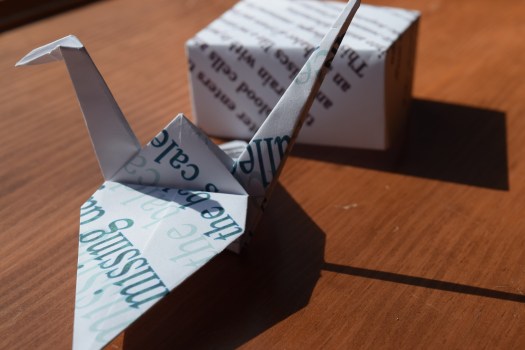
Poems “Accountability” (crane) and “Losing the Summer” (box) took shape when I printed the text onto the paper then folded it. New? Maybe.
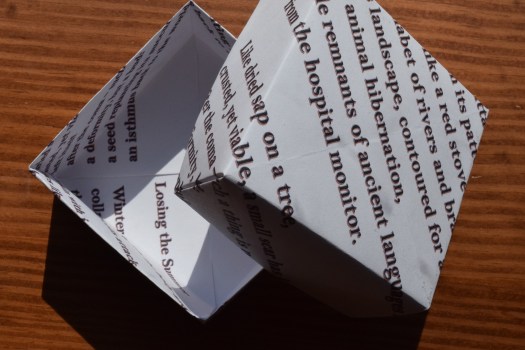
As part of the process, I had to figure out how to get the text to anticipate the folds, not as easy as I thought it would be. More to the point, I had to start to see ahead to the folds. Where the words appeared on the paper was important. Without the dexterity of a good design program, this proved more complicated than my four-o’clock self really could handle. After a few print outs (and font fun), I could find a balance between words and no words. My poems are more permanent to me in print–for this project I want typed words, not handwritten ones. 
There was also the matter of what the actual poem says. I want the words to mean what they mean as a stand alone poem, but also in this new manifestation of versigami. “Losing the Summer” worked well because it’s about, well, loss–the missing pieces. I liked that as a visual theme as much as a written one. 
I would like to experiment more with shape, text, process, and finality.
The poem was featured in Four Blue Eggs and recently cited in Gaylord Contributions so maybe versigami a way to reinvent it, update and give it additional life.
Amy Nawrocki was on summer break from her freshman year at Sarah Lawrence College in June of 1992 . . . [Read more
Origins. Versigami, transience, permanence, folded and unfolded. “Such a thing is not /
“Such a thing is not /
a deformity, but a bud.”
A wintery poem from Lune de Miel, Paris honeymoon, marriage, aging, and how the past maps itself out in pieces to be collected when you get there.
At the Café Select
Rue Montparnasse bustles outside the café window. It seems that there are very few hours of daylight in the Paris winter, though perhaps when something is condensed we can find the best part of it, like the pulp of a nut. As I watch passers-by folly onward, I listen to the voice of an American man talk about his life to a companion. I’m surprised when I turn my head to see that she is a younger woman. With my back turned to him, I imagined him telling his story to an old Navy buddy or a colleague he’s met for business. She is my age and this reminds me that I’m a week away from my thirty-fifth birthday. I hear him tell her about success, and he uses words like celebrate and thrive. But then his voice dims and I wonder if perhaps he’s slipped into French; perhaps I am just lost in the gloomy sidewalk, the gray pavement only a few shades deeper than the sky.
Later I catch him say that he doesn’t feel like a success; he pauses and continues with “in some ways more than a success.” “I have survived,” he notes. I guess his age to be seventy, perhaps, a few years younger than my father when he died, a few years younger than the ash-haired woman with a cane who passes by the window. The woman wears a tweed coat that falls just past her knees; her pale stockinged legs move slowly, even with the aid of a third. Her success is quieter, though both journeys have fought off the closing of many hours. I doubt that this as an adequate measure of success, though I like the simplicity of such an idea, as if all we had to do was float like tree branch down a long river.
The café-crème is cold by the time I turn my attention back to it, and having to strain now to hear their conversation, I lose interest in the man and his companion. Instead, I glance up to see my new husband writing a story about a little Danish boy whose mother dies. I think of my father and mother who both missed our wedding, and I wonder about the river’s end. As my thirty-fifth year comes to its end, I may be halfway there, to the moment when I recount my hours and ponder the scope of my successes. For now, I put on my own tweed coat, reach for my husband’s hand, and trace another’s steps down the boulevard.
Click on “a story about a little Danish boy. . . ”
for the current issue of The Passed Note, a journal which features “The Wind Barrons of the Pharo Islands” by Eric D. Lehman, the very story described.